

John Hoyland: Britain's Answer to Abstract Expressionism
John Hoyland RA (1934-2011) was a seminal figure in British painting in the mid-to-late twentieth century, particularly notable as one of the very few British abstract painters whose work stands comparison with the major American abstract expressionists - including Pollock, Rothko and Frankenthaler - who dominated mid-twentieth century abstraction. In the words of art critic Peter Fuller "the British art world needed an answer to abstract expressionism…and Hoyland fitted the bill. He's a virtuoso, he has enormous dexterity in the slickest imaginable sense. It's certainly abstract painting. And to me, it's abstract in the most limited sense of all. It's painting which is confined to a particular area of experience, the area of painting itself."
For the broader intellectual context to Hoyland's explosive compositions of colour it is useful to look across the Atlantic, specifically to Clement Greenberg's 1948 essay The Crisis of the Easel Picture. Greenberg's essay seeks to understand and provide an academic framework for the radical techniques the American abstract expressionists were exploring in their work, notably the free-flowing and gestural application of paint which dominated their large-scale canvases. Greenberg's essay explored how the "all-over" abstract painting presented a challenge to the easel painting convention, since "it infects the notion of the genre with a fatal ambiguity," dispensing - as it does - "with beginning, middle, end." Greenberg sought to illuminate the 'crisis' of the easel picture by explaining developments in art history which align with the general direction he saw modernism taking, starting with Manet and the impressionists, the post-impressionists in the late nineteenth century and continuing into the early twentieth century with Picasso and Braque's creation of cubism. Each sequential movement extended painting's development into abstraction, but particularly the reduction of painting to its core qualities. Greenberg saw the work of wholly abstract painters as fitting into a wider progression of art history and the next stage of this development was the embrace of medium specificity or, as it became known, formalism. Greenberg's concept of formalism advocated for painters to explore the material qualities of paint - colour, form, texture - and to embrace the two-dimensionality of the canvas, which in turn would push the horizons of paint into new territory.
While Greenberg's ideas provided some of the intellectual rationalisation for abstract painting in post-war America, in Britain it was the London-born curator Bryan Robertson (1925–2002) and "his revolutionary exhibition programme at the Whitechapel [which] made a wide range of artists available to the startled eyes of post-war England". Robertson "was a key figure in Hoyland's life" and, perhaps naturally, Hoyland was strongly influenced by Robertson's staging at the Whitechapel of exhibitions dedicated to Jackson Pollock in 1958, Mark Rothko in 1961 and Robert Motherwell in 1966. These exhibitions, as well as a visit to New York in 1964, were essential to shaping Hoyland's vision. Hoyland’s relationship with American abstraction was not, however, confined to paintings encountered in British galleries. In 1964, travelling to New York on a Peter Stuyvesant Foundation bursary, he entered into direct contact with many of the artists who had transformed his understanding of painting. Hoyland visited the studios of Robert Motherwell, Barnett Newman and Mark Rothko, encountered previously unseen paintings by Morris Louis and met figures including Kenneth Noland, Jules Olitski and the influential critic Clement Greenberg. It marked the beginning of a sustained relationship with the American art world. Between 1964 and 1973 Hoyland returned frequently to the United States, at times working there and developed close friendships with several of its leading painters.
These encounters placed Hoyland in an unusual position among British painters of his generation. The New York School was no longer simply a distant source of influence; Hoyland had encountered its leading protagonists personally, seen their working environments and participated in the artistic milieu from which their painting emerged. Yet this proximity did not make him an American imitator. Rather, the encounter provided Hoyland with a language of scale, colour and abstraction which he increasingly subjected to his own instincts, helping to establish a form of painting that remained distinctly his own.
But for a visceral appreciation of what Hoyland stands for, Six Days in September, a short film produced by the BBC in 1979, shows Hoyland embarking on his campaign to produce a painting. Hoyland battles against his huge canvas by slashing swathes of paint onto the ever-evolving surface. During the apparent chaos and mess, he offers a sporadic insight into his mind and his thought process, explaining that "you can't really think about colour" but instead "you respond to colour" a phrase that echoes the expressionistic and free flowing nature of Pollock. At the end of the film the result of Hoyland's efforts is a painting which encapsulates the hybrid nature of his art - on the one hand it's a product of chance and expression thrown onto a canvas, and on the other it is a calculated outcome, seen through the harsh division of colour that leads from one corner to the next, creating a sense of intentional structure. As the film concludes, we see Hoyland contemplate the painting: he steps back, analyses the composition and colour, assess his next steps and, ultimately, he stops.
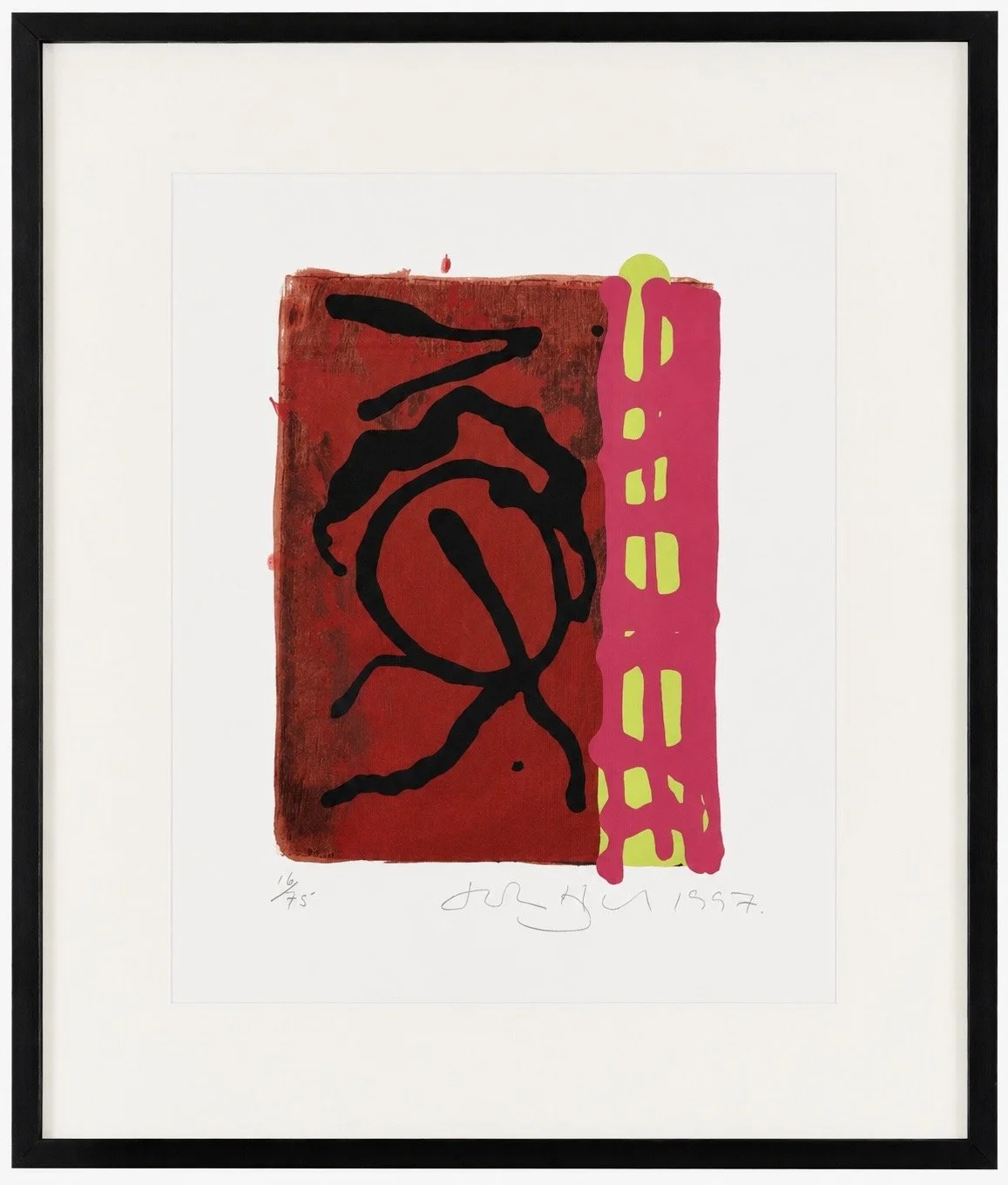
Going back to Greenberg's Crisis of the Easel Picture, the process which Hoyland undertakes in the film and the results which he produces fit perfectly with Greenberg’s idea of an artist exploring the possibilities of paint's material value as a means of pushing the medium into its next stage of art historical development. The British writer and art critic Andrew Lambirth provides a further insight into the outcome which results from the seemingly wild techniques deployed by Hoyland, describing how "Hoyland encourages the viewer's eyes to roam across his paintings, not to get stuck on a focal point, but to move about through the different layers and levels, the clusters of incidents, the various areas of interest."
John Hoyland was able to harness a rare set of skills - the ability to mix expression with an instinctual feeling for colour. It is a combination which runs powerfully through his oeuvre and positions him as an artist who triumphantly converged two of the driving forces of twentieth century abstraction.
Sources:
Clement Greenberg, The Crisis of the Easel Picture, 1948
Andrew Lambirth, John Hoyland: Scatter the Devils, (Norwich: Unicorn Press, 2009)
BBC iPlayer, Six Days in September, Six Days in September