

The Neglected Genius of Post-War Sculpture
Robert Adams (1917-1984) was widely acknowledged as one of Britain's foremost sculptors in the post-war decades, but unlike fellow artists from the Geometry of Fear group - including Kenneth Armitage, Lynn Chadwick and Reg Butler - or the British Constructivists, including Victor Pasmore, Mary Martin and Adrian Heath, recognition of Adams' talents has not continued after his death. The critic Brian Glasser described Adams as the "neglected genius of post-war sculpture" when reviewing Adams' retrospective at Gimpel Fils gallery in 1993, a poignant phrase which inspired the title of this essay and underpins its main theme.
Adams' public career as an artist really began in November 1947, when Adams was 30 and Gimpel Fils hosted his first one-man exhibition in London. The exhibition was to start both his commercial career and an enduring artist-dealer relationship, with Adams remaining with the gallery for the rest of his life. Gimpel Fils was established in 1946 by brothers Charles and Peter Gimpel on Duke Street, London, "one of only a handful prepared to deal in contemporary British art." Gimpel Fils was unique, since the post-war art world of London was relatively conservative compared to Paris and New York, meaning that "there were few adventurous patrons" and positioning Gimpel Fils, with its roster of artists such as Adams, as pioneers in the exploration of the possibilities of abstract sculpture at this time.
Building on Adams' initial exhibition with Gimpel Fils he would go on to receive institutional attention and recognition in Britain, culminating in the group exhibition Young Sculptors which was curated by the hugely influential critic and curator David Sylvester at the ICA in 1952. The ICA exhibition really set the stage and foreshadowed the international success the exhibiting artists such as Robert Adams, Kenneth Armitage, Reg Butler, William Turnbull and Eduardo Paolozzi would receive at the Venice Biennale that same year. Robert Melville's piece in Harper's Bazaar praising the Young Sculptors exhibition encapsulates the critical reception of the occasion and explains how the emerging artists in the ICA exhibition represented a natural evolution from the work of Henry Moore, working in a way that "replaced the craft of the stone-mason with the craft of the blacksmith, the industrial skills of the welder and the model." Melville singled out Adams, describing how "his early vertical forms are in poetic correspondence with the human figure, and they suggest that he could have successfully applied this remarkable inventiveness to the art that attributes life to inanimate objects. His forms have something that I am forced to call 'vitality.' They are constructions in space which seem to trace out sharp, spontaneous, arbitrary movements of the mind." The same year Adams represented Britain at the 1952 Venice Biennale, leading to his affiliation with the 'Geometry of Fear' group, a phrase coined by art historian and critic Herbert Read when writing his review of the British Pavilion. Yet despite Adams' involvement with the group, Read noted that Adams stood apart from his contemporaries, "isolated in his architectonic pursuits: he builds his forms with small but compacts masses, generally of wood", an observation which was likely to have been inspired by Adams' Venice-exhibited sculpture Divided Pillar, 1950. As suggested by Read, it is clear that Adams' involvement in post-war artistic developments extended beyond the existentialist and semi-figurative aesthetic that emerged with the Geometry of Fear group and is illustrated through Adams' parallel involvement with the British Constructivists.
The British Constructivists were informally led by Victor Pasmore, who had denounced figuration in 1947 and subsequently plunged himself into abstraction, with a loose-knit group of Constructivists emerging at the London Group in 1951. Inspired by the utilitarian qualities of the Soviet Constructivists, Pasmore's explanation of his new approach to art was based on how "the whole world is shaken by the spirit of reconstruction. In the realm of the arts, those that belong to the visual senses have been most affected in outward form. In painting and sculpture, as also in architecture, an entirely new language has been formed bearing no resemblance at all to traditional forms." It is clear that Pasmore was standing against the developments of artists such as Lynn Chadwick and Kenneth Armitage - where the semi-abstract human form was often a proxy for the anxieties of post-war Europe - instead advocating for an industrial, purely abstract notion of art-making built around simple, architecturally-inspired forms. Pasmore's conceptual exploration of art's crossover with architecture resonated with Adams and was carried into his practice a decade later when he once again represented Britain at the 1962 Venice Biennale, which saw the appearance of his Screen Forms. The Screen Forms emerged as "one large sheet buckled and so Adams, making a virtue out of necessity, cut it into segments which he reassembled... Adams apparently made almost no preliminary drawings but would draw direct on the steel with chalk to indicate where it should be cut or drilled. The link between his sculptures and his lithographs is now close, even technically, and it is possible that he used the small, triangular steel planes cut for his sculptures to block out the compositions of the lithograph."The Screen Forms as a recurring motif are ambiguous in their depiction, appearing as both a door, a window and - as the title suggests - a typical screen, but their unique configurations deny them the ability to be considered figurative depictions, leaving them to exist in a liminal space. Screen, 1965, in the Sainsbury Centre collection reveals the technical skill involved in producing these sculptures, as jagged, triangular forms are welded together in a dispersed composition, across one universal pane, a process that Adams himself described as seeking to "present stability and form in one movement."
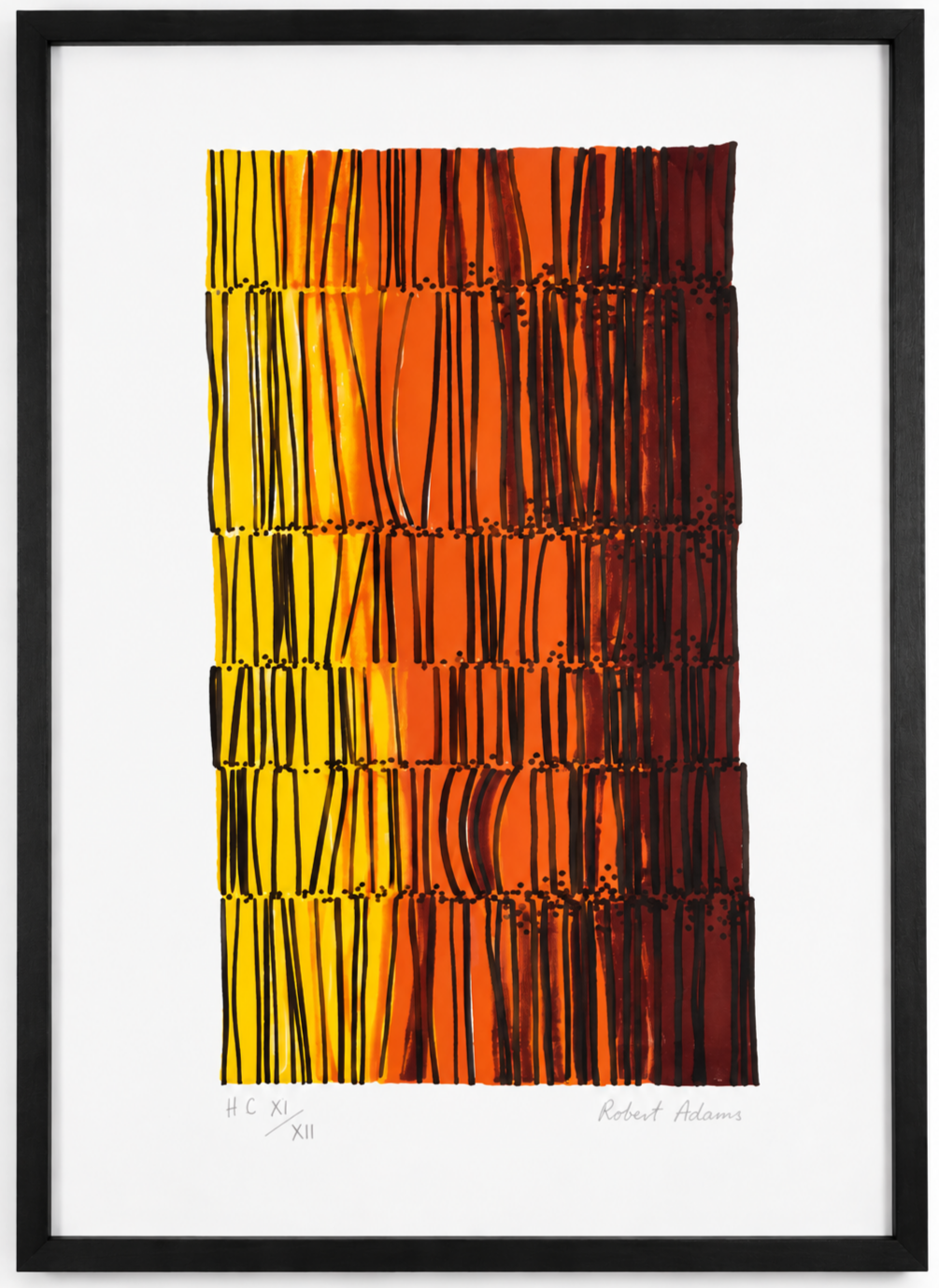
Adams' participation in the 1962 Venice Biennale, a decade after the impact of the 1952 edition, supports a more independent narrative surrounding his practice, as he exhibited in 1962 alongside Ceri Richards and Hubert Dalwood. As discussed, Adams' work had developed a clear formal language and a more focused visual identity, demonstrating both technical precision and an enduring engagement with the conceptual concerns of his Constructivist past. By the 1960s, Adams' practice appears to have moved beyond the artistic cohorts with whom he had been associated during the previous decade.
Adams' involvement with some of the most pivotal artistic groups and movements of the 1950s, a period of fervent change, was amply recognised by contemporary critics, a theme which this piece has set out to bring to the surface once again. Adams was by no means a bit player in these key moments; Gimpel Fils, the most avant-garde dealer of the time, saw his talents early and championed his work, which was also acknowledged and singled out by leading authorities in British art history of the time such as Herbert Read and David Sylvester. But although his posthumous reputation has not yet been propelled to the lofty heights of some of his immediate contemporaries, Robert Adams' work was revered in his lifetime by peers and curators alike and it deserves a comprehensive reassessment.
Sources:
Alastair Grieve, Robert Adams 1917-1984: A Sculptor's Record (London: Tate Gallery, 1992)
Alastair Grieve, Constructed Abstract Art in England: A Neglected Avant-Garde, (New Haven: Yale University Press, 2005)
Tate website, ‘Robert Adams' accessed 16.05.2026, Robert Adams 1917–1984 | Tate
Sainsbury Centre Collection: Robert Adams, Screen, 1965