

Graham Sutherland: Landscapes of the Mind
Graham Sutherland (1903-1980) has often been seen as one of the greatest English landscape painters of the twentieth century. John Hayes, a leading academic and the director of the National Portrait Gallery for twenty years, described Sutherland in his 1980 monograph as having a "highly personal style that placed him, with artists such as Henry Moore, in the front rank of the avant-garde in Britain."
Sutherland's art draws on deep interconnections in British art. Sutherland had met the young Francis Bacon in the early 1940s and became a fully-salaried war artist between 1940 and 1945. Sir Kenneth Clark, the leading mover behind the War Artists' Advisory Committee, noted that Sutherland had an ability to combine the British Romantic tradition with Surrealism: "Poetical painting should come naturally to the English; actually it is rare…Graham Sutherland does so. His colour and design are a joy to the eye, but they exist and acquire their force through his magical vision of nature". Hayes also placed Sutherland in a great continuum of English landscape visionaries, stretching back to Samuel Palmer in the early nineteenth century. The raw subjects of both artists are distinctively the English landscape in their choice of earthen colours and tones, but for each their depictions take on an idiosyncratic, other-worldly aspect.
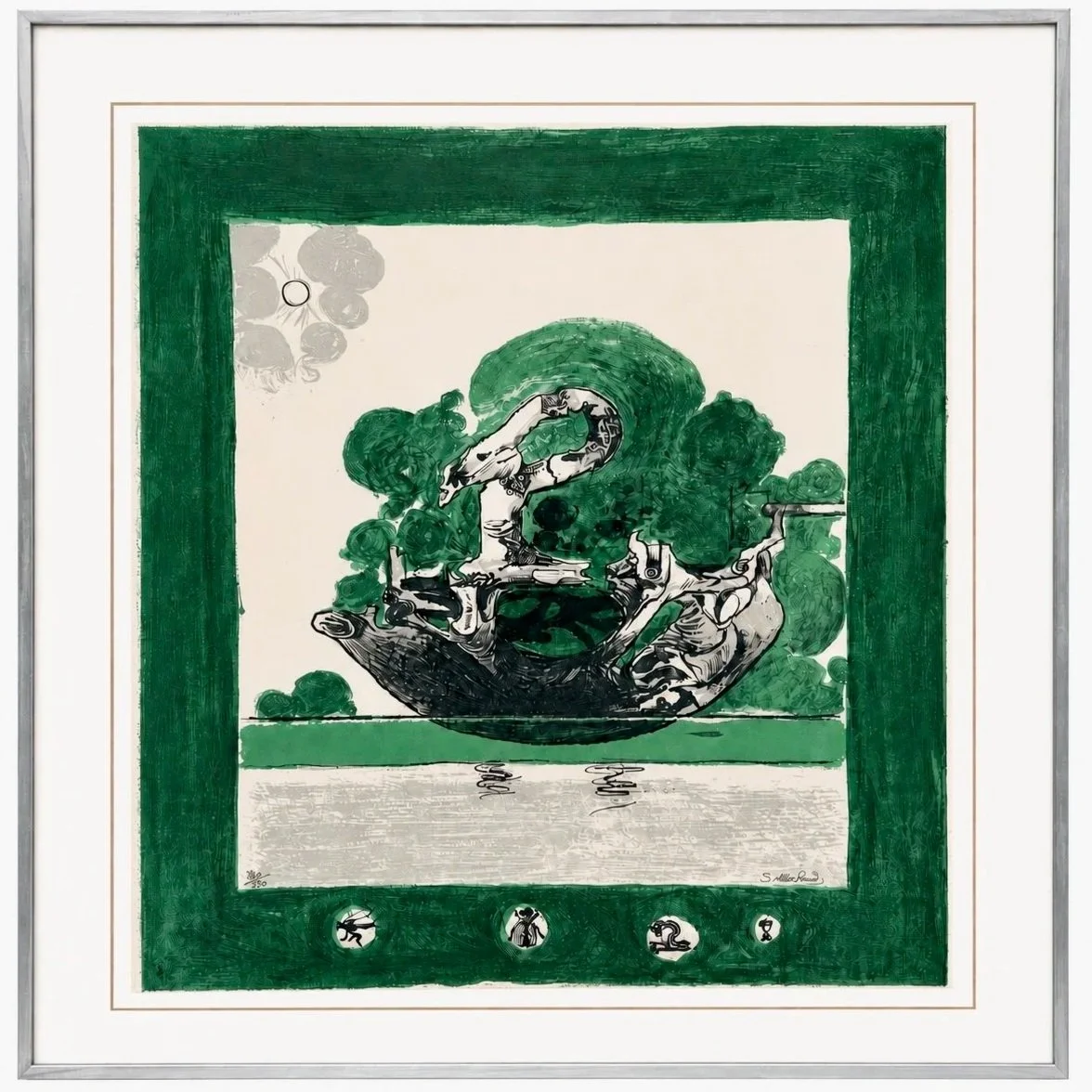
Sutherland had begun his career as an engraver, studying at Goldsmiths in the 1920s, developing "from 1925-1928…mannered, dreamlike, pastoral romanticism which derived from Palmer's visionary years." The images which Sutherland produced in this brief, early period of his career carry intense connotations of Palmer and were rooted in romantic sentiment but - perhaps fortunately for us - this derivative period was not to last. Sutherland instead developed his own, more personal, style from the late 1920s into the early 1930s, culminating in prints which were "charged with a new force." His work from this period foreshadowed the characteristic mature style of his later work, as seen in Swan Like Form, 1971, which strikingly illustrates the distinct style for which Sutherland had become known - a style which is semi-figurative, with echoes of Surrealism, but always grounded in the earthy tones which recall the English countryside. "As a professional painter Sutherland was treading a lone path" and - encouraged by his friend Paul Nash, one of Britain's leading surrealists - Sutherland's paintings had begun to resemble "the English response to abstraction and surrealism", characterised by semi-abstracted landscapes of the English countryside, shaped by a palette of organic pigments.
While Sutherland's perception and depiction of the English countryside did not follow the conventional figurative tradition of other landscape artists, it was instead imbued with a deeply unique psychological charge that is best described in Sutherland's own words: "the parts of the scene as they reach the mind, lose their normal contiguity, the isolated forms their identity, and all become absorbed in the reservoir of the subconscious mind out of which emerge the reconstructed and recreated images." The quote encapsulates Sutherland's thought-process as an artist who would engage with his surroundings in the real world, then depict the murky and fragmented recollection of his memory when producing his pictures - a process that remained with the artist throughout his career.
Sutherland's semi-figurative, quasi-surrealist subjects took a variety of guises throughout his life, culminating in a range of themes including Swan Like Form, in which the central elongated shape echoes the curvature of a swan's neck. The contrasting area of green surrounding the central form depicts a characteristically Sutherland landscape: jaded, blurred and ambiguous, but with just enough visual cues and forms referencing the figurative world to place the image firmly within the English landscape of the artist's exceptional mind.
Sources:
John Hayes, The Art of Graham Sutherland, (Oxford: Phaidon Press, 1980)
Sir Kenneth Clark quoted in Recent Works of Graham Sutherland (exh. cat.), (Rosenberg and Helft, London, 1938)